Wisdom for the Weekend

A piece of wisdom to ponder over the weekend. I share this because I know from experience it is easy to forget. From THE INNER GAME OF TENNIS. 

“But who said that I am to be measured by how well I do things? In fact, who said I should be measured at all? Who indeed? What is required to disengage oneself from this trap is a clear knowledge that the value of a human being cannot be measured by performance – or by any arbitrary measurement. Do we really think the value of a human being is measurable? It doesn’t really make sense to measure ourselves in comparison with other immeasurable beings. In fact, we are what we are; we are NOT how well we happen to perform at a given moment.”

Something to ponder.

Embracing The Struggle

As Brene Brown says, ” We are hardwired for struggle.” Yet it’s tempting to try to manage our way around it or pull back rather than embrace it, even though we know it’s the struggle and challenge that provide the stimulus for our becoming better athletes and better people.

In his book Listening Point, Sigurd Olson has a short chapter on The Paddle. He writes, ” The paddle is made of native ash from a tree that grew in a cold swamp and gathered its toughness from bitter springs and cold falls when even staying alive had been an effort… into the new paddle went those qualities of texture and spirit that develop only under stress.”

Those qualities of texture and spirit grow in us  through our efforts to respond to the difficult days of training, the  match with a tough opponent, the recovery from an injury. When we rise to meet the challenge, like that ash tree rising from the cold swamp, reaching for the light, we too gather that toughness and resilience.

It takes patience though. The new growth rarely happens overnight whether it’s physical strength or changing an attitude. As Olson writes about his paddle, ” It’s fineness of grain came from slowness of growth, some so fine it could barely be seen with the naked eye, evidence in those sections that life had been difficult.” 

So what’s the challenge you’re facing? Improving a skill; developing a physical quality; changing an attitude or a belief? Maybe it’s not even on the field. Maybe its a difficult conversation you need to have with a teammate or coach or player.

Whatever it is, embrace the struggle. Match your efforts with time to rest. That’s part of the process too. But, embrace the struggle. It’s where the transformation begins.

And, part of what you may discover is, that transformation allows you to bring even more to the people, and causes you care about.


Mobility For Health And Performance

img_2972Two years ago I met Kelly Quist. Kelly works for the Minnesota Twins as their massage therapist and stretching specialist. She had been practicing something called Fascial Stretch Therapy™ and invited me to experience it for myself. The results were so noticeable that I sent one of the track sprinters I was working with to see her. A strained quad from a year and a half earlier was healed but, tightness in it kept her from reaching top speed and anxious about straining it again. With one session she was able to train and compete with confidence. She continued with FST for the season.

Mobility is a huge issue in both the health and performance of an athlete. Ranell Hobson of the Academy of Sport Speed and Agility in Australia gives an example of the connections in a helpful blog post here https://playerdevelopmentproject.com/football-mobility/ . As she points out, if the hip flexors are tight, the hips are pulled into constant flexion and the gluteals can’t perform their function. There is a loss of power, stability and an increased likelihood of injury. 
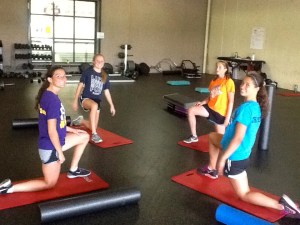
img_1666Coaches and trainers will often tell players to stretch and may even take time before or after practice to do it. I know we do. It can help in some cases. But, it tends to focus only on specific muscles and not on the net of connective tissue and muscles that work together to help us move. So the effects while beneficial are limited.

That’s what is so impressive about FST and why I spent time in Phoenix this January getting trained and certified. It is great to be able to bring it back to our Kick-It! Athletes.

While traditional stretching addresses specific muscles, typically in a static way, FST addresses full fascial lines throughout the whole body. Because FST uses a whole-body concept based in anatomy and functional movement, it results in improved flexibility gains over traditional stretching.

back-and-front-lines-together-1

If you watch the NFL on Sundays or you’ve watched the summer Olympics you’ve most likely watched athletes who use FST.

For players who are interested, I’m offering times on Sundays and Wednesdays to come in for half hour sessions to get a quick assessment and begin the process of increasing mobility and flexibility. In the past few weeks I’ve been able to help athletes increase ankle and hip mobility and improve their vertical jump and squat. There is no extra cost or charge for this for players who are currently training with us although there are a limited number of slots right now due to current training schedule.

If you want to learn more about Fascial Stretch Therapy™ you can check out this short video from the Stretch To Win Institute or visit their website.

To sign up just click here, pick a day and time and hit submit.

Looking forward to unlocking speed, strength, and power with FST.
 

A Score Is Not A Story

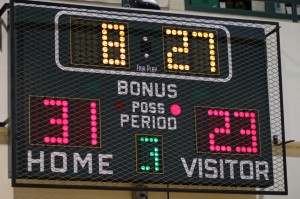
SCOREBOARDWe were doing assessments yesterday; times, distance, height, weight. Lots of numbers. High school lacrosse players starting a new training cycle. Hockey players wrapping up and preparing for tryouts. The hockey players are pumped, measuring their progress and improvement over the last 6 months; taking confidence from their results as they head in to their season. For the lacrosse players its a different experience. The summer season ended almost two months ago and they’ve only been in the gym for a couple of weeks. Scores take a dip when you take a break. That’s OK. Its even a good thing. In a world where we’re constantly being evaluated, graded and compared though, it’s easy to get stuck on the numbers. Rather than seeing them as a snapshot we look at a single measurement as a trend and, if the trend is down something must be wrong.

But, as my son-in-law, a former golf pro, said after our round last week, ” A score is just a number, it’s not a story.”
Hockey Player Turning on Ice
The real story for the hockey player is in the discovery and development of their potential and, seeing how hard work in the gym and on the ice combined with good choices about things like nutrition can pay off. For the lacrosse players it’s learning to see how the long arc of training is cyclical. It’s about learning to trust the rise and fall that are part of the rhythm of training and long term development.
iStock_000011469617Medium
So, we let the lacrosse players know that they’re not getting slower or weaker. They’re at a particular spot in the cycle. And, we let the hockey players know that they can take confidence from the numbers they put up and that the bigger story will be unfolding on the ice over the next weeks or months.
Numbers are just numbers. They only mean something within the context of a given players unique development – within that players story. It’s critical that coaches and parents help young athletes remember that their scores are just one way of knowing where we are at a given moment in that story it’s never the whole story and certainly not the end.

Want To Open Up Your Players Potential? Try Changing Your Metaphor.

The industrial metaphor dominates our world these days. We think in terms of inputs, outputs, and efficiency.  Heck, even the FOX NFL mascot isn’t a player, it’s a robot. The factory mentality has an impact on the way we see players, and the way we see our role as coaches and even parents. An industrial model is great for producing quality cars and big screen TV’s. Not so great for developing people.

In the short ( 2:00 ) video below Sir Ken Robinson offers a different way of thinking about developing people. Good teachers, he says are like good gardeners.  ” A good gardener depends on plants growing under their care  – otherwise they’re out of business. Yet, the irony is every farmer and gardener knows you can’t make a plant grow. The plant grows itself. What you do is provide the conditions for growth.”

In his book, The Talent Code, Daniel Coyle notes the same quality in the master coaches he observes, ” Their personality – their core skill circuit – is to be more like farmers: careful, deliberate cultivators of myelin … They possess vast, deep frameworks of knowledge which they apply to the steady, incremental work of growing skill circuits, which they, ultimately, don’t control.”

Maybe that’s the big part of changing the metaphor. In the factory you  control the input and the output. When you’re teaching or coaching, you don’t.  It’s an act of service, in a long term process where the most important work is done by the players or the student. It requires patience, faith and a different way of seeing the world and ourselves.  But hey, as Joseph Campbell said, ” If you want to change the world, change the metaphor.”