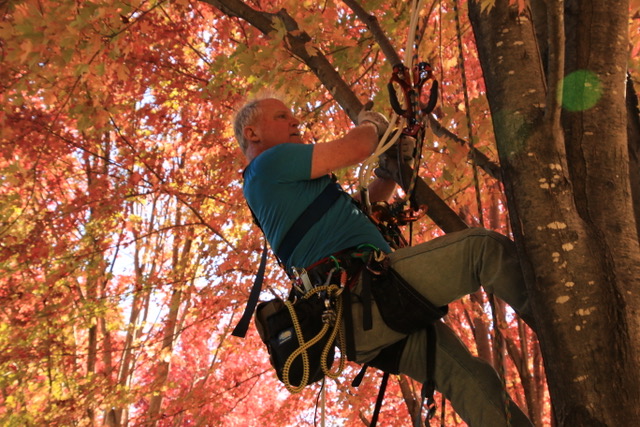
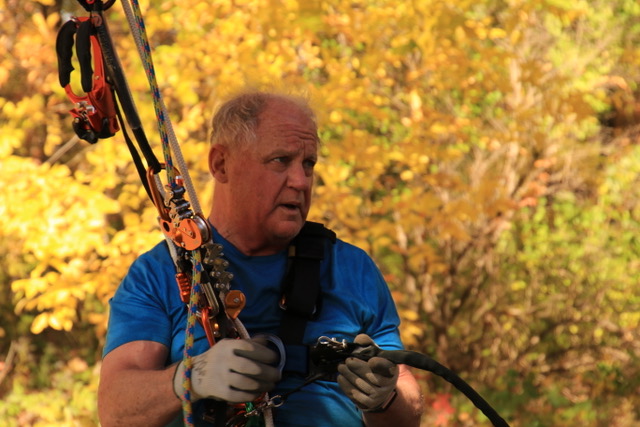
This guy is amazing. A few days ago I was with him in the woods behind his house watching him up in the trees where he likes to hang out ( pun intended).
What’s cool about this is that he’s 70 and this is a new interest he’s taken up in the last few years.
He’s done a few things that all of us can learn from. First he is clear about what’s important to him, his health, the people he cares about and the earth. Second, he has a team of people he turns to and trusts to stay healthy and well. He’s not trying to do it alone or figure it out by himself. Third, he is constantly learning and growing. Reading, asking questions, applying what he’s learning all the time. Our coaching sessions are always conversations about understanding the theory and then putting it into practice.
Purpose, connection and a desire to learn: three things that keep us unfolding and developing for a lifetime.
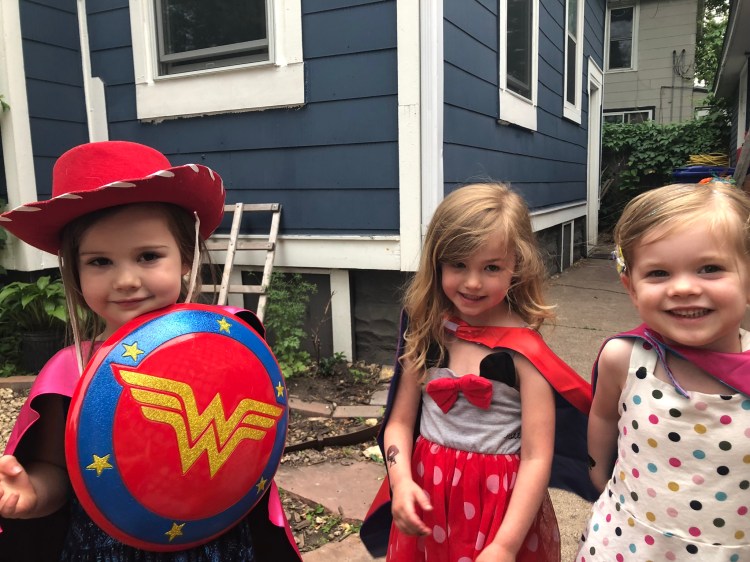
This week my five year old friend shared with me that she was sad because she didn’t know if she would remember how to make friends when she starts back to Kindergarten in a few weeks or when she finally gets a chance to take dance classes.
No amount of reassurance was going to flip her into a better mood. So, instead of trying to convince her I asked her to tell me about a time she made a new friend. Where was she? What did she do? How did it work out? When she finished I asked her to tell me about another time and then another. She shared a story about sitting next to a girl on the school bus who was by herself and then one about going over to a boy who was playing by himself and a third one about another girl at her school.
We discovered as she shared that not only did she remember how to make friends. This little girl had superpowers, a knack for engaging others who were alone and starting up a relationship. Pretty soon she was saying, “yeah I’m good at making friends.”
Two things to ponder here. The first is evidence is a poor substitute for experience. There was no way I was going to persuade her that she would be fine. Drawing on her experience though helped her connect with her unique gift and style for making friends. She hadn’t forgotten how. Like most of us it was just below the surface waiting to be called back up.
The second thing to think about is how we need each other to call those gifts and superpowers and strengths back up. When we aren’t seeing it, that simple question, “tell me about a time when…” creates the opening we need.
Dr. Melissa Peet, in her work at the University of Michigan and The Generative Knowledge institute has developed the science and the art of this approach. Please check her work out. Whether you do it as a coach, a friend, a teammate or a partner, it’s something you’ll want to learn and something we all need.
For my little friend it was enough to move her from anxious to eager.
Every summer the college soccer players come home to start their training. Every summer they come back a little de-conditioned after finals and a little time off and so the first few sessions are hard. But, slowly we increase the volume or the intensity and every few weeks back it down to let them catch up and adapt and after the second or third cycle they start to feel it; the slow accumulation of their efforts and their increasing level of fitness. By the time they leave to report back in August they are doing workouts that are twice what they started with and feeling challenged but within themselves.
The magic isn’t in the program. That’s based on sound principles that anyone can use. So, it’s not the program that gets the results. It’s the fact that they keep at it. Week after week, session after session they show up and do the work and then follow it up with sleep and nutrition and rest. Sometimes keeping at the rest and recovery is more challenging than the workouts but that’s another post.
To keep at anything over time is the real key to moving forward. And, to keep at it, it helps to have companions, other people who are keeping at it and who can lift you up, remind you it’s worth it and tell you, you got this when the commitment ebbs. ( and it will)
We also need to trust the process. When the end seems a long way off and you aren’t seeing your progress you need to make yourself vulnerable, lean in and trust before you have the evidence, that not only is this going to work – it already is working.
Keeping at it is a skill and vulnerability and trust are the muscles we build as we practice. Because, as they say, here’s the thing. Those athletes are going to have to come back again, next summer, to prepare for another season. We don’t get in shape once and forever.
The same is true for whatever quality we’re working on. Those qualities are really skills and they need to be practiced and refined and renewed all the time whether it’s strength, or kindness, speed or confidence, power or patience.
So, pick a quality and approach it as a skill.
Get yourself some good coaching, someone who can help you with a solid plan.
Find a companion or two to help you work the process.
Average is a statistic not a person. There is no such thing as an average human being.
In 1950 the U.S. Air Force measured 140 dimensions of over 4000 pilots to help improve the design of the cockpits of their airplanes. The idea was if you could determine the dimensions of the average pilot you could design a better cockpit. A young Lieutenant named Gilbert Daniels calculated the average of the ten dimensions believed to be most relevant for the process. Daniels compared the measurements of pilots to the average and was shocked to find not a single pilot fit the average on all ten measurements. Even if you took the average of only three measurements fewer than four percent would qualify. There was no such thing as an average pilot. You would have been designing a cockpit for someone who didn’t exist.
Todd Rose has researched and written about the idea of average extensively in his work at Harvard. His book The End Of Average is well worth the read.
When it comes to comparing two different groups of people, like people who exercise or meditate regularly with people who don’t, it can be helpful. But, when we try to apply it to an individual human being like what’s the best form of exercise for you or how much stress is too little or too much for your friend it’s useless, because like the pilots in Daniels work, no one is average. Here’s where we need to take the time and do the work of coming up with the right fit, the one that helps you be the best you. Rather trying to fit the person into the program we really can create the program that fits the person. And it’s a lot more fun.
Flexibility isn’t about being able to bend over and put your palms on the floor or do the splits. Flexibility is just what it says; your ability to flex, to adapt, change, respond to changes in your environment.
Mobility, stability, strength, coordination, strength and stiffness all go into making us flexible and they can all be practiced and developed. One of the keys to developing them is choosing the activities that actually help you develop them. Another factor is matching level of challenge with our ability to recover, learn, and adapt or grow.
The ability to change and respond in healthy ways to the changes in our environment (internal and external) is a good measure of the health of any organism. A much better measure than whether or not you can sit in the lotus postition.
The optimist doesn’t say everything is fine or even that everything is going to be fine. The optimist just knows that we have within us and around us what we need to rise to meet the challenge and if we fail, to get back up, learn, adapt and rise to meet it again. It allows them to be curious, grateful, even joyful as they embrace the moment, put their toe on the line and say, “let’s go.”
What good coaches do is listen, patiently for those “simple, quiet opportunities”, as Wayne Muller called them, to shift the pattern, to help the people they serve explore and create the possibility of something better, something more in line with what they know can be.
Photo by u0421u0430u0448u0430 u041bu0430u0437u0430u0440u0435u0432 on Pexels.com
A few years ago I had two high school hockey players come to me asking for a little help. They had both broken an arm during hockey games in the same week. Now they were out for 4-6 weeks while they healed and they wanted to know if I would help them stay fit and strong so that they were ready to go when their casts came off.
The first thing we had to know was, what their limitations were. Some of those came from the doctors and were obvious, like no weight bearing exercise with the injured arm. But, some were things you might not think of, like no vibration in the injured arm and making sure that what we did wouldn’t put them at risk of a fall that could cause even more harm. So, no skating for a while and no dry land stick work either because of the vibration.
Once we knew the limitations, what we couldn’t do, we could get to work on the things we could do: leg strength, mobility, coordination, conditioning, recovery and mental skills. A month later both girls returned to the ice, fitter than before, well rested and with renewed enthusiasm.
The change of scenery helped them recharge as well as heal and the reason we were able to change the scenery was because we recognized the limitations, accepted them and worked with them. We didn’t deny them, fight them or get stuck in them. We honored them, because they gave us an important part of the framework for healing. We created the rest of the framework based on what we could do. Bowing to the limitations was the starting point for moving forward.
One of my coaches, Dr. Melissa Peet, introduced me to the idea of the holiness of limitations. If you’re not familiar with her work you should check it out. It’s powerful and it will help you think differently and better about creating change for yourself, the people you care about and serve, and your community.
In a nutshell its this: when you come up against your own limits and you choose to honor them, to bow to them, you accept your vulnerability and that vulnerability is what allows for the movement, for finding a way forward.
A final quick story about the hockey girls. The first day they showed up for training they came from class, so their long hair was down and hanging loose around their shoulders. They reached into their equipment bags with their left hand to grab a pony tail holder, then with their right hands tried to gather their hair and slip on the holder. You can probably guessed what happened. With a cast that that runs through your palm and immobilizes your thumb you can only grip with one hand. They looked at each other for a second, started to laugh and then helped each other put in their pony tails.
Bow to your limitations, accept your vulnerability, put in each other’s pony tails and get on with it. The holiness of limitations.
In April, astronaut Mark Kelly gave an interview about what his time in space had taught him about living through quarantine and stay at home orders. After he talked about the importance of a routine and exercise he said, “The other thing is pace yourself. For me, I think one of the most important things for me getting to the end of that mission in space was, with as much enthusiasm and energy as I had in the beginning, was the appropriate pace. ”
Pace, according to the Cambridge dictionaryis the speed at which someone or something moves, or with which something happens or changes.
Matching that speed to the amount of energy we have, and the amount of energy required to accomplish our task or reach our goal requires wisdom, focus and listening to our body. We need a sense of how much energy we are using, how fast we are replenishing it, and how much progress we’re making.
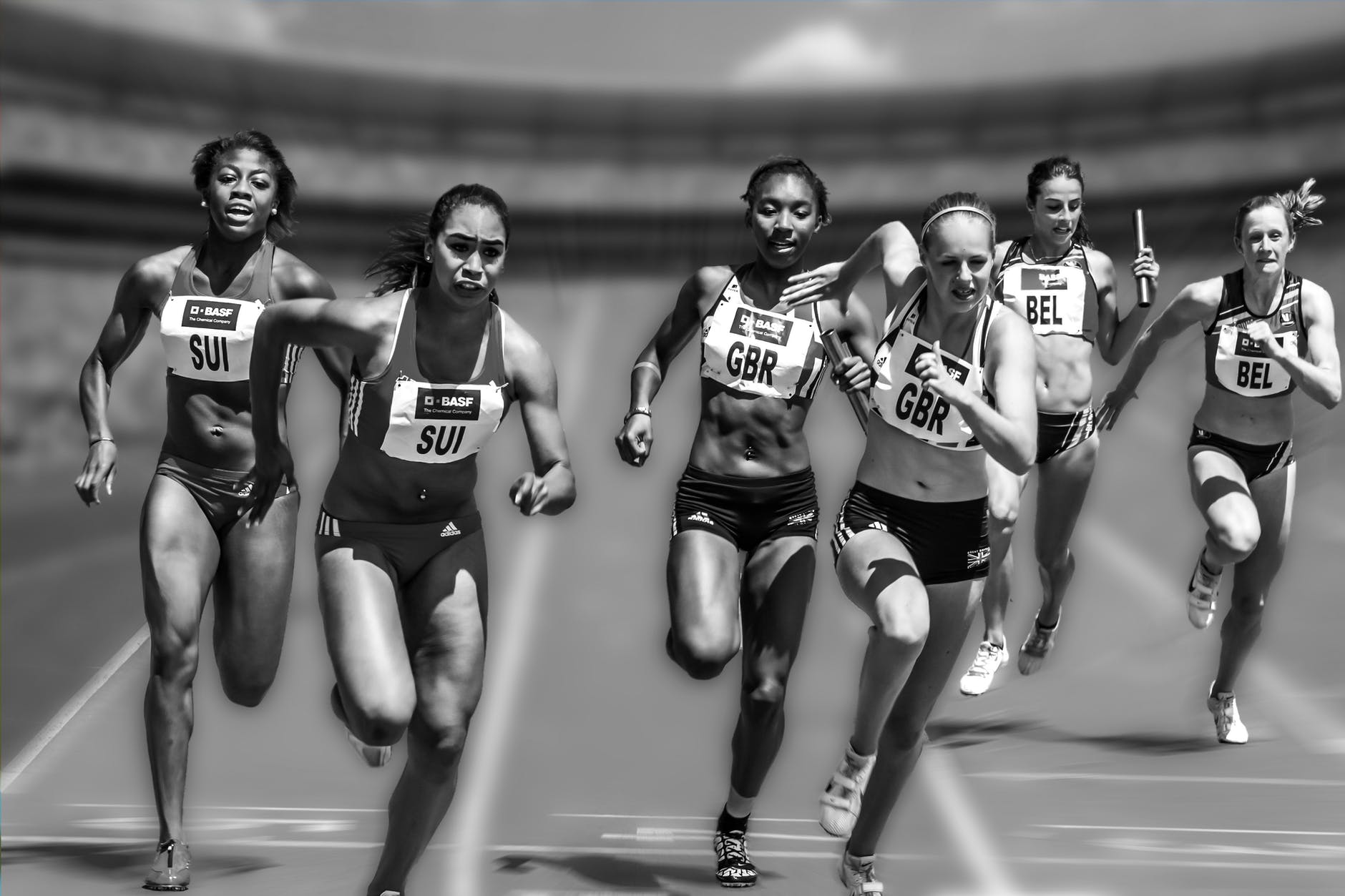
It’s a challenge, especially in times like these when you don’t know exactly where the finish line is. Still, pace gets us through the race. In some races finishing is winning. It is better to cross the line with a little extra in the tank, sprint at the end or pull others across with us. Wisdom, focus and listening help us cross the line and that’s where we want to be.





 FLOW STRETCH AND MOVEMENT